
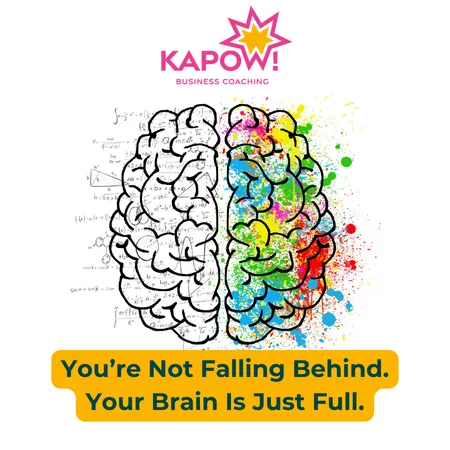
I think a lot of people are mistaking cognitive overload for personal failure right now.
They are telling themselves they are procrastinating, disorganised, undisciplined, bad at focus or somehow behind everybody else. But when you actually listen to what people are carrying mentally at the moment, it is no wonder their brains feel full.
Business pressure. Home pressure. Financial pressure. Industry change. Constant information. AI conversations. Networking. Content creation. Learning new tools. trying to stay visible. Trying to stay relevant. Trying not to miss opportunities.
It is relentless.
And what I’m noticing more and more is that people are functioning in a constant state of low-level mental overload while trying to behave as though everything is fine.
That creates some really interesting behaviour patterns.
People jump between tasks because they cannot settle. They start five things and finish none. They consume more information every time they feel uncertain. They search for the perfect system instead of making a decision.
There is constant reorganising, constant tweaking and constant preparing, but rarely a feeling of being finished.
I had a conversation recently with someone who described feeling like they were drowning. Not because they were doing nothing. Quite the opposite.
They were doing too much mentally.
They were trying to hold every task, every responsibility and every future possibility in their head all at once.
And this is the bit I think many people underestimate.
Mental load is not just about the number of tasks you have. It is about the number of unfinished loops your brain is trying to keep open simultaneously.
Every unanswered email. Every postponed decision. Every half-started idea. Every thing you know you “should” do.
It all takes energy.
Add AI anxiety into that mix and suddenly people feel as though they should also be reinventing themselves professionally at the same time.
That is a huge amount for one brain to carry.
Especially when the wider online world keeps rewarding urgency.
Everything currently feels framed as:
Move faster. Learn more. Adapt quicker. Post more. Optimise everything.
And if you are already mentally overloaded, that pressure often creates paralysis rather than momentum, because when everything feels important, your brain struggles to prioritise.
So instead, people drift.
They answer easier emails. They switch tabs. They research another tool. They tidy systems. They save another post to “come back to later.”
It creates the feeling of productivity without the relief of completion.
I also think many people are carrying a strange kind of guilt right now.
Guilt for not being more productive. Guilt for struggling to focus. Guilt for feeling tired. Guilt for not adapting quickly enough.
But very few people are acknowledging how much change has happened in a very short space of time.
Professionally. Technologically. Emotionally. Socially.
Humans are adaptable.
But adaptation still takes energy.
And one of the most useful shifts I’ve seen clients make recently is realising they do not need more intensity.
They need fewer open loops.
That can look surprisingly simple.
Writing things down instead of mentally carrying them. Creating recurring processes instead of reinventing tasks. Reducing unnecessary decisions. Accepting that not everything needs optimising. Recognising where responsibility actually ends.
That last one is particularly important.
I see so many people carrying stress that does not actually belong to them. Clients are not responding. Projects are delayed because other people have not delivered. People are trying to manage everybody else’s emotions, timelines and expectations.
At some point, you have to recognise the line between responsibility and over-responsibility.
Otherwise your nervous system never fully settles.
And when your nervous system never settles, your thinking becomes scattered.
This is also why relationships and environments matter so much right now.
Some spaces increase noise. Others reduce it.
Some conversations leave you feeling inadequate and behind. Others leave you feeling calmer, clearer and more capable.
That distinction matters more than people realise.
Because when somebody is already cognitively overloaded, they do not necessarily need more information.
They need perspective.
They need structure.
Sometimes they simply need someone to help them separate what genuinely matters from what is just noise.
I think this is partly why relationship-led networking is becoming more valuable again too.
Not performative networking. Not pitching rooms.
Actual conversations. Actual relationships. Actual trust.
People are craving spaces where they can stop performing certainty for a moment.
And ironically, those calmer spaces often create far better business opportunities than frantic visibility ever does.
The same applies to business support.
Many people are not struggling because they lack intelligence or ambition.
They are struggling because they are trying to process too much in isolation.
Sometimes having someone help you simplify, prioritise and create rhythm is the difference between permanent overwhelm and genuine momentum.
And I think that is the conversation we need to have more honestly in business.
Not:
“How can I become infinitely more productive?”
But:
“How can I create a way of working that my brain can actually sustain?”
Because burnout does not usually arrive dramatically.
More often it arrives quietly through constant low-level overload, constant mental switching and constant unfinished thinking.
People convince themselves they just need to push a bit harder, learn a bit more or optimise a bit further, when often the real answer is simplification.
Not withdrawal from ambition. Not lowering standards.
Just removing unnecessary friction.
If you have been feeling scattered, mentally noisy or permanently behind lately, it may not mean you are failing.
It may simply mean your brain is overloaded.
And perhaps the next step is not adding another system.
Perhaps it is finally creating enough space to think clearly again.
That is a big part of what I help people do through Focus Support.
Not by adding more pressure, but by helping them create calmer momentum, clearer priorities and more sustainable ways of working.
Because sometimes the most productive thing you can do is reduce the noise.
What is cognitive overload?
Cognitive overload happens when the amount of information, decisions, interruptions and unresolved work competing for attention exceeds a person’s available mental capacity. It can make capable people appear indecisive, distracted or unproductive even when they are working hard.
It is not the same as laziness or a lack of ambition. A person may be cognitively overloaded when they are repeatedly switching tasks, forgetting small details, delaying decisions, rereading information without acting on it, or feeling unable to choose where to begin.
The key issue is not only workload. It is the combination of active tasks, uncertainty, notifications, emotional responsibility and future planning that the brain is attempting to process at once. Reducing that load often improves focus more effectively than adding another productivity method.
How do you know whether you are cognitively overloaded?
Cognitive overload can look like busyness without meaningful progress. Common signs include:
- Moving between emails, messages and tasks without completing a priority.
- Researching tools, templates or advice as a substitute for making a decision.
- Feeling that every request is urgent and struggling to rank what matters.
- Starting work with energy but losing concentration quickly.
- Keeping reminders, obligations and ideas in your head because they have no trusted external home.
- Becoming unusually tired after routine decisions or conversations.
- Feeling guilty during rest because unfinished responsibilities remain mentally active.
These patterns can also have other causes, including stress, burnout, sleep disruption or health concerns. Persistent or severe difficulty functioning is worth discussing with an appropriately qualified healthcare professional.
Why unfinished tasks consume so much attention
Psychologist John Sweller’s cognitive load theory explains that working memory has limited capacity. When too many items require attention at the same time, it becomes harder to learn, reason and make decisions. In everyday work, unfinished tasks can create this pressure because each one carries an implied next step: reply, decide, check, plan or follow up.
An “open loop” is any commitment or question that has not been resolved, scheduled, delegated or deliberately dropped. Examples include an invoice needing approval, a client awaiting an answer, an idea saved for later, or a decision about which AI tool to test.
The practical goal is not to finish everything immediately. It is to give each loop a clear status outside your head: do next, schedule, delegate, wait for, archive or decline. This reduces the need to repeatedly remember it.
A 20-minute reset for cognitive overload
- Capture: Write down every task, worry, unanswered question and commitment currently competing for attention. Do not organise while capturing.
- Clarify: For each item, identify the next visible action. Replace vague entries such as “sort marketing” with an action such as “choose one topic for this week’s post.”
- Sort: Put each item into one of five groups: do now, schedule, delegate, waiting for someone else, or remove.
- Limit: Choose one priority task and no more than two supporting tasks for the current work period.
- Protect: Close unrelated tabs, silence non-essential notifications and set a point at which you will review incoming messages.
This process works because it externalises memory demands and turns unclear obligations into decisions that can be acted on.
Further reading on stress, cognitive load and work design
Readers who want to explore the underlying concepts can consult these established sources:
- American Psychological Association: https://www.apa.org/topics/stress
- Centers for Disease Control and Prevention, coping with stress: https://www.cdc.gov/mental-health/living-with/index.html
- John Sweller’s work on cognitive load theory: https://www.tandfonline.com/doi/abs/10.1207/s15326985ep4104_2
- World Health Organization, mental health at work: https://www.who.int/news-room/fact-sheets/detail/mental-health-at-work
These resources do not diagnose an individual’s experience. They provide useful context for understanding how sustained demands, limited attention and workplace conditions can affect concentration, wellbeing and decision-making.